
Earn money with Muse bot is the question behind a wave of videos and posts that promise passive income from Meta’s new AI agent, and the short answer is that Muse has paid users 0 dollars. There is no creator programme, no payout system, and no passive income inside Muse. Muse is Meta’s personal AI agent, launched on 8 September 2026, and it runs on the Muse Spark model. It is a helper that can save you time on work that already earns money, but it is not a money machine, and it is not available in India or Pakistan. That is the honest short answer, and the rest of this check explains what Muse really is, what its plans cost, what the referral tokens are worth, and the five real ways people earn with it instead of from it.
Earn money with Muse bot has a short quotable answer. Muse has paid users 0 dollars, because there is no creator programme, no payout system, and no passive income inside it. Muse is Meta’s personal AI agent, launched on 8 September 2026, and it runs on the Muse Spark model. It can save you time on work that already earns money, like running a small business or selling things online, but it does not pay you for using it. It is not available in India or Pakistan, and Meta has announced no launch date for either country.
Earn Money With Muse Bot: What Muse Actually Is
The first thing to understand about earn money with Muse bot is what Muse actually is, because the earning myth starts with a wrong idea of the product. Muse is Meta’s personal AI agent, launched on 8 September 2026. It is not a game, not a task app, and not an earning platform. It is an assistant that lives inside Meta’s apps, including WhatsApp, Messenger, Instagram and Facebook, and it also works on the web and in its own app. You talk to it in plain language, and it can answer questions, plan things, draft messages, and carry out small jobs for you.
Muse runs on the Muse Spark model, which is Meta’s own AI model family for this agent. The agent can connect to other services through connectors, and the list Meta has shown includes Shopify, Stripe, QuickBooks, Klaviyo, Canva, Slack, Asana, Notion and Zoom. That means a small business owner can ask Muse to check orders, draft replies, or organise admin work, and Muse can do it by talking to those connected apps. That is the real value of Muse. It saves time on admin, and time saved is useful, but it is not the same as money paid.
The confusion comes from the word bot. In the earning app world, a bot usually means an app that pays you for taps, tasks, or watching videos. Muse is a different kind of bot entirely, an AI agent that works for you, not a machine that pays you. Meta’s plan for making money from Muse is also different from the usual earning app model. Meta plans to earn through subscriptions and small transaction fees, not through ads, according to Mark Zuckerberg in Meta’s third quarter 2026 earnings call. A product that charges you a subscription is the opposite of a product that pays you, and that is the first clue that the earning claims are a myth.
Earn Money With Muse Bot: The 0 Dollar Payout Fact
The payout question is where most earn money with Muse bot searches actually lead, so here is the fact in plain words. Muse has paid users 0 dollars. There is no creator programme, no partner programme, no payout dashboard, and no way to withdraw money from Muse, because there is no money to withdraw. A YouTube test of the earning claim, posted about five days before this check, reached the same conclusion after trying the product, and the independent reviews agree. The site alwaysongtm.com, in its own write-up, says plainly that Muse does not pay users, and the 88labs.ai guide to making money with Muse reaches the same finding. Those are their findings, not ours, but they match every official fact Meta has published.
That zero is not a secret and it is not a trick. Meta has never announced a creator fund, a revenue share, or a payout for Muse users. The product page on muse.ai describes an assistant, not an earning opportunity, and the plans page lists prices you pay, not money you earn. When a video promises that Muse pays you for chatting, or that you can earn passive income by leaving it running, it is describing a product that does not exist. No amount of chatting, no prompt trick, and no referral code turns Muse into a payout machine, because the payout system was never built.
The myth spreads for a simple reason. Every big AI launch brings a wave of videos that promise easy money from the new tool, and the videos earn their makers ad money while the viewers earn nothing. The pattern is the same every time, a new app launches, a video says it pays, and the claim travels faster than the correction. The correction here is short. Muse is a time saver, not a money machine, and anyone who tells you otherwise is selling you a video, not a payout.
Earn Money With Muse Bot: Free, Power and Maximum Plans
The plans are where the earn money with Muse bot myth falls apart completely, because Muse charges you instead of paying you. There are three plans. The Free plan costs nothing and gives you basic access. The Power plan costs 20 dollars a month and gives you 500 million Muse tokens a week. The Maximum plan costs 100 dollars a month and gives you 3 billion Muse tokens a week. Tokens are usage credit, which is how much AI work you can ask Muse to do, and when the tokens run out, you wait for the next week or you pay for a higher plan.
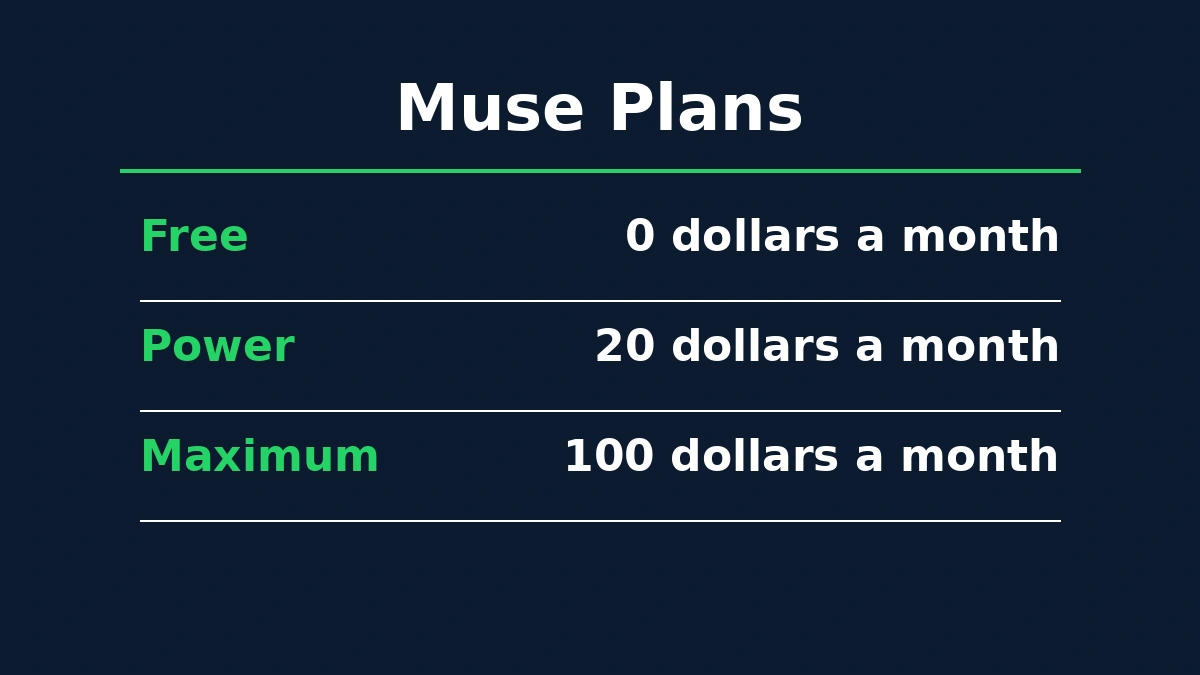
One detail matters for the free plan. Meta has not published the exact free tier limit. Mark Zuckerberg’s launch post put the free tier at 100 million tokens a week, and that figure is attributed to his post, not to Meta’s official plans page, so treat it as his stated figure rather than a published limit. The point is the direction of the money. On every plan, you pay Meta, or you use a free allowance Meta gives you, and at no point does Meta pay you. An earning claim that asks you to pay 20 dollars a month to earn money is not an earning opportunity, it is a subscription, and the subscription buys AI help, not income.
| Detail | What we checked |
| Launched | 8 September 2026, by Meta |
| AI model | Muse Spark model family |
| Free plan | Basic access, limit not published |
| Power plan | 20 dollars a month, 500M tokens a week |
| Maximum plan | 100 dollars a month, 3B tokens a week |
| Creator payout | None, Muse pays 0 dollars |
| How Meta earns | Subscriptions, transaction fees |
| Available in | US, Canada and Japan only |
| India launch | Not available, no date announced |
| Official website | Muse official website |
| Independent review | Can you make money with Muse, Always On TM |
| Ads link in this table | Download |
| Related Muse check | Muse App Download USA |
Earn Money With Muse Bot: The Referral Token Grant Explained
The referral grant is the one part of earn money with Muse bot that has a real number attached to it, and it is also the part most often misread as cash. New users who redeem a referral code in Settings within 48 hours of joining get 1 billion Muse tokens. That figure comes from the review site perk.hk, which verified it on 24 October 2026, and it is their finding, not ours. One billion tokens sounds like a fortune, and some posts present it as free money, but tokens are usage credit, not cash, and they cannot be withdrawn, transferred, or sold.
To see what the grant is actually worth, compare it with the Power plan price. Power costs 20 dollars a month for 500 million tokens a week, so 1 billion tokens is about two weeks of Power allowance, worth about 9.23 dollars at Power prices. That is a comparison, not a cash value, and the tokens only save you money if you were going to pay for Power anyway. If you use the free plan, the grant gives you more AI work for free, which is useful, but it puts no money in your pocket. A token is a unit of AI work, not a unit of currency, and treating it as cash is the same mistake as treating a free coffee voucher as a salary.
One rule follows from that. No referral code is published in this article, because a referral code is a way to earn tokens, not a way to earn money, and sharing one would only spread the same confusion this check is clearing up. If someone offers you a Muse referral code and promises you cash for using it, they are either confused about what tokens are, or they are using your signup to earn tokens for themselves. Either way, the reward is tokens, and tokens are not money.
Earn Money With Muse Bot: Is Muse Available in India
The availability question is where most earn money with Muse bot searches from India and Pakistan hit a wall, because Muse is not available in either country. As of late October 2026, Muse is available in the United States, Canada and Japan, according to perk.hk, and no launch date has been announced for India or Pakistan. One video review described it as available in the United States and Canada only, which matches the same picture from a slightly earlier date, and the wider point is the same in both versions. If you are in India or Pakistan, you cannot sign up for Muse yet, and no date has been given for when that will change.
That matters because the earning videos rarely mention the region limit. A viewer in India watches a video that promises money from Muse, tries to download the app, and finds it is not offered in their country. The app store numbers show how big the launch has been where it is available. On the App Store in the United States, Muse holds 4.85 stars from 331,897 ratings as of October 2026, and on Google Play it holds about 4.7 stars from about 108,000 reviews with more than 5 million downloads. Those are real numbers from real users in the launch countries, and they say nothing about India, because India is not in the launch yet.
If you do find a way to use Muse from India, through a work around or a borrowed account, think twice before you build anything on it. An account that depends on a region trick can stop working without warning, and work you did inside it can become hard to reach. The honest step is to wait for the official launch, and to treat any video that promises Indian payouts from Muse today as a claim about a product you cannot even open yet. The launch will come when Meta announces it, and until then the earning question is closed for Indian users, because the product itself is not here.
Earn Money With Muse Bot: 5 Real Ways to Earn With It
The real question is not how to earn money with Muse bot, it is how to earn money with Muse, and that small change of words changes the answer completely. You cannot earn from Muse, but you can earn with Muse, by using it to do work faster, better, or at a bigger scale than you could do alone. The five ways below are all real, and they all follow the same rule. Muse does the admin, you do the earning, and the money comes from a customer, not from Meta.
1. Small business admin
The first way is small business admin, and it is the use Meta itself talks about most. Muse connects to Shopify, Stripe, QuickBooks, Klaviyo and Slack, so a shop owner can ask it to check orders, draft replies to customers, summarise sales, and organise the day. None of that pays you directly, but it frees hours that a busy owner would otherwise spend on admin, and those hours can go into selling, sourcing, or serving customers. The earning comes from the business, and Muse is the helper that keeps the business running smoothly.
2. Selling unused stuff
The second way is selling unused stuff, which is the fastest way for most people to turn a phone into cash. Muse can help you write clear listings, take better descriptions from your notes, price items by comparing similar listings, and reply to buyers politely and quickly. The buyer pays you, the platform takes its fee, and Muse never touches the money. That is a normal sale with an AI helper, not a payout from Muse, and the difference matters, because the money is real and it comes from a real buyer.
3. Freelance and side business operations
The third way is freelance and side business operations. A freelancer can use Muse to draft proposals, plan projects, organise client work, and keep track of deadlines across Asana, Notion and Zoom. A writer can plan articles, a designer can organise briefs, and a small agency can keep client work in order. The client pays the freelancer for the finished work, and Muse only makes the work faster. The rate is yours, the client is yours, and Muse is the assistant that helps you deliver on time.
4. Content planning
The fourth way is content planning. Muse can help plan a content calendar, draft outlines, research topics, and organise ideas for a channel, a page, or a blog. A creator who posts regularly needs a steady flow of ideas, and planning is the slow part that Muse can speed up. The earning still comes from the platform that pays creators, from ads, sponsors, or sales, and Muse only helps you plan. A plan is not a payout, but a good plan is what makes a payout possible, and that is the honest place for Muse in a creator’s work.
5. Print on demand and digital packs
The fifth way is print on demand, digital packs, and agency services. Muse can help design product ideas, write descriptions for a print on demand store, plan a digital pack of templates or guides, and organise client work for a small agency. The customer buys the product or the service, and the money goes to you, minus the platform fee. Muse helps with the words and the organisation, and you keep the business. That is the same pattern as the other four ways. Muse works, you earn, and the money comes from a customer.
| Way to earn with Muse | Who pays you |
| Small business admin | Your own customers |
| Selling unused stuff | The buyer of your item |
| Freelance operations | Your freelance clients |
| Content planning | Your platform or sponsors |
| Print on demand, digital packs | Buyers of your products |
Earn Money With Muse Bot: The Risks and the Amazon Block
The risks are the part of earn money with Muse bot that the earning videos never mention, and they are worth reading before you hand Muse any real work. The biggest public warning came on 21 September 2026, when Amazon blocked Muse. Amazon stopped the agent from working with its shopping service, which means Muse cannot be trusted to handle shopping, orders, or money tasks on every platform. A tool that one big platform blocks is a tool with limits, and those limits matter when money is involved.
The second risk is letting an AI agent handle money or customer work without supervision. Muse can draft a reply, but it cannot take responsibility for a wrong refund, a wrong order, or a promise made to a customer in your name. If Muse sends the wrong message to a customer, the customer blames you, not Meta, and the cost of fixing it is yours. The safe habit is simple. Let Muse draft and organise, and check everything before it goes out, especially anything that touches money, customers, or orders. An assistant that you do not check is not an assistant, it is a risk.
The third risk is the cost. Muse is free to start, but the free allowance is limited, and the Power plan costs 20 dollars a month while the Maximum plan costs 100 dollars a month. If you pay for a plan to chase an earning idea that does not exist, you lose money instead of making it, and the subscription keeps charging while you wait for a payout that will never arrive. Add the privacy point too. Muse connects to your apps and your accounts to be useful, and that connection is powerful, so check what you connect and keep the connections to the apps you actually need. The tool is real, the risks are real, and both deserve the same honest reading.
Earn Money With Muse Bot: Our Checked Verdict
The checked verdict on earn money with Muse bot is clear, and it is a myth bust, not a maybe. Muse has paid users 0 dollars, because there is no creator programme, no payout system, and no passive income inside it. Muse is Meta’s personal AI agent, launched on 8 September 2026, running on the Muse Spark model, and it charges you a subscription instead of paying you. The Free plan costs nothing, Power costs 20 dollars a month for 500 million tokens a week, and Maximum costs 100 dollars a month for 3 billion tokens a week. The referral grant of 1 billion tokens is usage credit worth about 9.23 dollars at Power prices, not cash, and it cannot be withdrawn. Those facts are all checkable from Meta’s own pages and from independent reviews.
The conditions matter as much as the verdict. Muse is available in the United States, Canada and Japan as of late October 2026, and it is not available in India or Pakistan, with no launch date announced for either country. Amazon blocked Muse on 21 September 2026, which is a reminder that the agent has limits, and unsupervised money or customer work is a risk you carry yourself. The app store numbers are strong where Muse has launched, with 4.85 stars from 331,897 ratings on the App Store in the United States and about 4.7 stars from about 108,000 reviews on Google Play, but those numbers describe a popular assistant, not a paying one.
Our advice follows from the check. If you want to earn money, do not wait for Muse to pay you, because it never will. Use it instead as a helper for work that already pays, like running a small business, selling things, freelancing, planning content, or selling digital products, and let the customers pay you. If you are in India or Pakistan, wait for the official launch before you build anything on Muse, and treat any video that promises payouts today as a myth. Earn money with Muse bot is best answered as no payout, no programme, and no India launch yet, and the real opportunity is to earn with Muse, not from it.
Keep Reading
Read more checked guides on invitelinks.in. Muse App Download USA covers how to get the Muse app in the United States. GroMo App Review covers a referral earning app with its own published figures. EarnKaro App Review covers cashback and affiliate earning in the same checked style.