
Fake WhatsApp group invite links are one of the fastest-growing online scams in 2026. You tap a link that looks like a normal group invite, and instead of joining a friendly community, you land in a trap designed to steal your money, your personal details, or access to your WhatsApp account. This guide shows you 7 clear warning signs so you can spot fake WhatsApp group invite links before you join, how to verify any invite link in under a minute, and exactly what to do if you already joined a suspicious group.
Here is the short version: a real WhatsApp invite link always starts with chat.whatsapp.com, always shows you a group preview with the group name and member count before you join, and never asks for money, OTPs, or bank details. If any of those things look off, do not tap join.
Also Read

Contents in This Article
- What Are Fake WhatsApp Group Invite Links?
- Warning Sign 1: The Link URL Looks Wrong
- Warning Sign 2: You Are Asked for Money, OTPs, or Bank Details
- Warning Sign 3: Unrealistic Rewards and Prizes
- Warning Sign 4: No Group Preview Appears
- Warning Sign 5: You Were Added Without Tapping Any Link
- Warning Sign 6: Pressure to Forward the Link Immediately
- Warning Sign 7: The Message Comes With Panic or Urgency
- How to Verify a WhatsApp Group Invite Link Before Joining
- What to Do If You Already Joined a Fake Group
- Frequently Asked Questions
What Are Fake WhatsApp Group Invite Links?
A fake WhatsApp group invite link is a link that pretends to invite you to a WhatsApp group but is actually built for something else. Sometimes it leads to a phishing page that copies the WhatsApp login screen. Sometimes it adds you to a group run by scammers who will pressure you into fake investments, lottery fees, or “registration charges.” And sometimes the link itself is not even a WhatsApp link at all, it just looks like one at first glance. All of these are varieties of fake WhatsApp group invite links.
Scammers love group invites because they feel safe. You already join groups through links all the time, so your guard is down. That is exactly what they count on. The good news: fake WhatsApp group invite links almost always leave clues, and learning to spot fake WhatsApp group invite links takes only a few minutes. Once you know the 7 warning signs below, you will catch most of them in seconds.
Warning Sign 1: The Link URL Looks Wrong
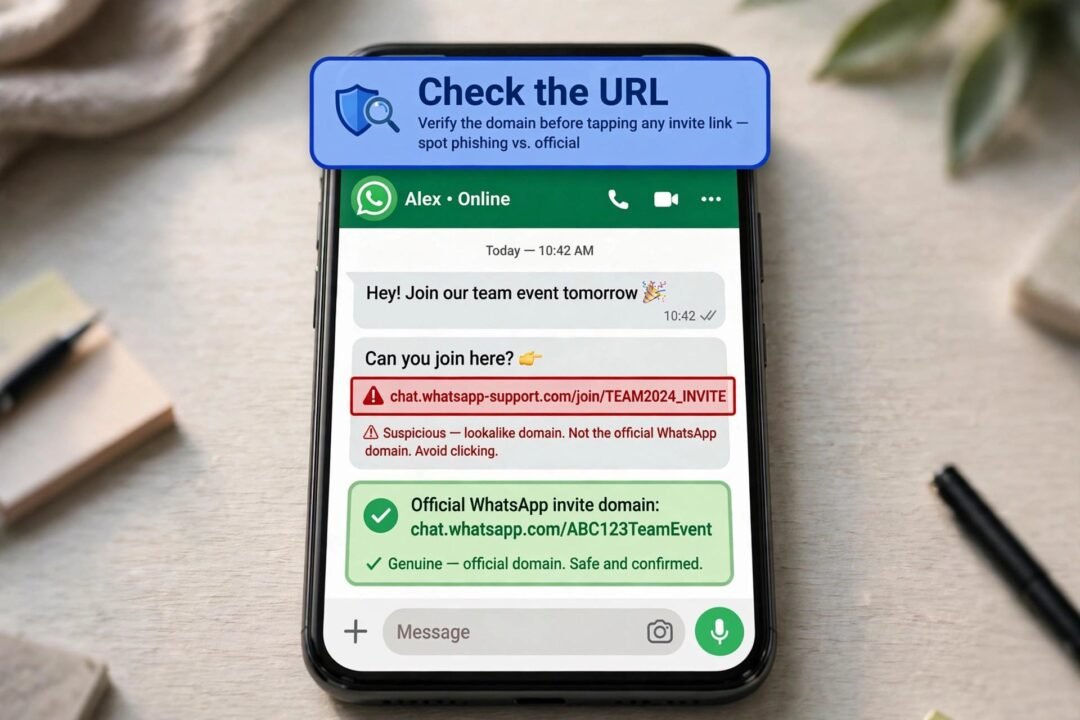
This is the single most reliable check. Every genuine WhatsApp group invite link starts with chat.whatsapp.com followed by a random code. That is the only official domain WhatsApp uses for group invites.
Fake WhatsApp group invite links often use lookalike domains: chat-whatsapp.com, whatsapp-group.net, wa-group-invite.xyz, or long URLs stuffed with the words “whatsapp” and “group” to look convincing. On a phone screen, especially inside a forwarded message, these can look real at a glance. Always tap and hold the link (or hover on desktop) to see the full URL before opening it.
What to do: If the domain is anything other than chat.whatsapp.com, do not open it. Delete the message.
Warning Sign 2: You Are Asked for Money, OTPs, or Bank Details
Joining a WhatsApp group is always free. Always. No real group admin will ever ask you to pay a joining fee, share a one-time password, or enter your bank or UPI details to “verify” your membership.
This is the most dangerous of all fake WhatsApp group invite links warning signs because it leads directly to financial fraud. A common pattern: you join the group, and within minutes an “admin” messages you privately saying your membership needs activation and you must pay a small fee or share the OTP you just received. That OTP is actually the code to take over your WhatsApp account.
What to do: Never share OTPs with anyone, ever. WhatsApp staff will never ask for your code. If a group asks for money to join, leave immediately.
Warning Sign 3: Unrealistic Rewards and Prizes
“Join this group and win an iPhone 16.” “Government scheme: Rs. 50,000 for every member.” “Double your money in 7 days, group members only.” If the group invite promises rewards that sound too good to be true, they are.
Scammers use prize bait because it works. Links dressed up as lottery groups, government benefit groups, or crypto doubling schemes spread fast through forwards, and most of them are fake WhatsApp group invite links. Once you are inside, the “admin” will ask for a small processing fee to release your prize. You pay, the prize never comes, and often you are asked to invite friends too, which spreads the scam further.
What to do: Ask yourself: would a real government scheme or company distribute prizes through a random WhatsApp group? If the answer is no, do not join.
Warning Sign 4: No Group Preview Appears
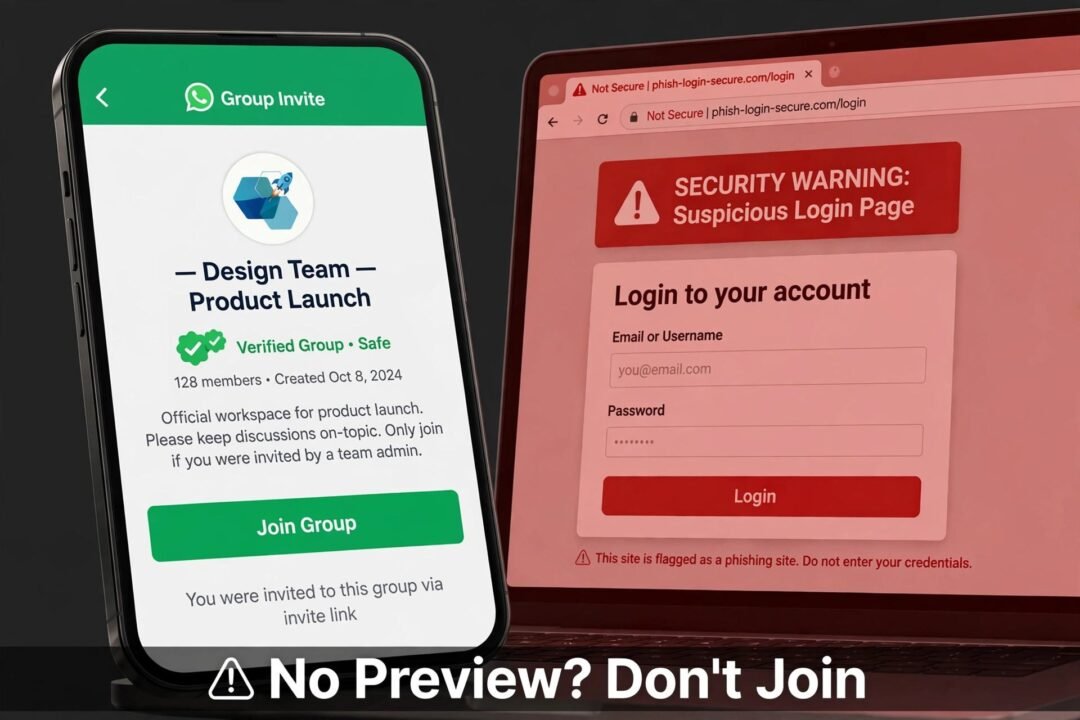
When you tap a real WhatsApp invite link, WhatsApp always shows you a preview screen first: the group name, the group icon, and how many members it has, with a clear Join Group button. You get to see what you are joining before you commit.
If tapping a link skips this preview, opens a browser page asking you to log in, or shows a strange loading screen instead, something is wrong. Phishing pages copy the WhatsApp look precisely to steal your phone number and verification code. A missing preview is one of the clearest warning signs of fake WhatsApp group invite links.
What to do: Only join from the official WhatsApp preview screen inside the WhatsApp app. If a link opens in a browser asking for login details, close it.
Warning Sign 5: You Were Added Without Tapping Any Link
Sometimes there is no link at all. You simply wake up to find yourself added to a strange group with a name like “Crypto Earnings 2026” or “Part Time Jobs Daily.” Anyone who has your phone number can add you to a group, and scammers buy leaked number lists in bulk.
Being added without your consent is itself a red flag. Legitimate communities invite you; they do not ambush you. These forced-add groups are often the starting point for fake WhatsApp group invite links scams: once you are in, the admins begin the prize or investment pitch described in the signs above.
What to do: Leave the group immediately. Then go to WhatsApp Settings, then Privacy, then Groups, and change “Who can add me to groups” to “My Contacts.” This one setting blocks most forced adds.
Warning Sign 6: Pressure to Forward the Link Immediately
“Forward this to 10 groups or the link expires!” “Only the first 50 members get the bonus, share now!” Real groups never need you to recruit for them under time pressure. This urgency is manufactured.
Scammers push forwarding because every forward is free advertising for their trap. Chain-forward pressure is a classic marker of fake WhatsApp group invite links, and it is also how misinformation spreads. If a message begs you to forward before thinking, that is your cue to think instead. Most fake WhatsApp group invite links depend on exactly this kind of blind forwarding to reach new victims.
What to do: Do not forward. If the group itself pressures members to recruit, leave it. You can also report the group from the group info screen.
Warning Sign 7: The Message Comes With Panic or Urgency
“Your account will be blocked in 24 hours, join this group to verify!” “Last chance, offer ends tonight!” Panic shuts down your judgment, and scammers know it. Urgent language, countdown timers, and threats of account closure are emotional tricks, not information.
WhatsApp never communicates account warnings through random group invites. Neither do banks, governments, or real companies. Any invite message that tries to scare you into tapping fast deserves the opposite response: slow down and check. Remember, fake WhatsApp group invite links rely on panic to bypass your judgment.
What to do: Treat urgency as a warning sign, not a reason to hurry. Verify through official channels instead. WhatsApp’s official FAQ is the right place to check how invites really work.
How to Verify a WhatsApp Group Invite Link Before
Joining
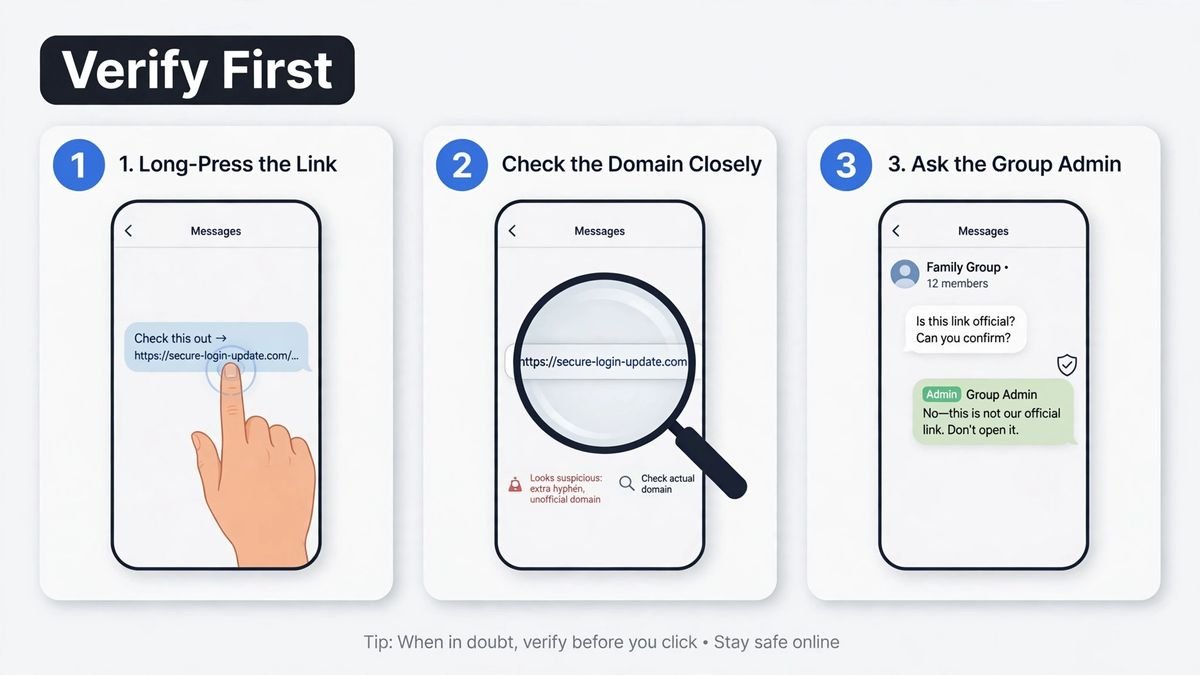
You can verify any invite link in under a minute with these 4 steps. Make it a habit and fake WhatsApp group invite links will rarely fool you. This quick routine is the best defense you have.
- Check the domain. Long-press the link to reveal the full URL. It must start with chat.whatsapp.com. Anything else is a no.
- Look for the preview. Tap the link and wait for the official WhatsApp preview screen showing the group name, icon, and member count. No preview, no join.
- Read the group name critically. Does it promise prizes, doubling money, or government benefits? Names making big promises are a red flag on their own.
- Check the sender. Did the link come from someone you know and trust, or a random forward? Even links from friends deserve the first three checks, because your friend’s account could be compromised.
Want groups that are already checked for you? Browse our list of active WhatsApp group links, where every listing is reviewed before it goes live.
What to Do If You Already Joined a Fake Group
Do not panic. Even if fake WhatsApp group invite links fooled you once, quick action limits the damage. Act methodically:
- Leave the group immediately. Open group info, scroll down, tap Exit Group.
- Block and report. Block the admin’s number and use the Report option in the group info screen so WhatsApp can act on the account.
- Never pay or share codes. If you already shared an OTP, re-register your WhatsApp number right away to lock scammers out, and turn on two-step verification in Settings.
- Warn others. If the link came from a friend, tell them their account may be compromised or that they forwarded a scam.
- Check your money. If you paid anything, contact your bank or UPI provider immediately to try to reverse the transaction, and file a complaint on your country’s cybercrime portal.
For more safety guidance, see our latest guides on joining online communities safely.
Frequently Asked Questions
Can a WhatsApp group invite link hack my phone?
The link alone cannot hack your phone, but what it leads to can harm you. Fake WhatsApp group invite links may take you to phishing pages that steal your login code, or into groups where scammers trick you into sharing OTPs or paying fees. The danger is in what happens after you tap, which is why verifying first matters.
How can I tell if a WhatsApp group link is real?
Three quick checks: the URL starts with chat.whatsapp.com, tapping it shows the official WhatsApp group preview with name and member count, and nobody asks you for money or OTPs. If all three are true, the link is almost certainly genuine, and you can rule out fake WhatsApp group invite links.
Is it safe to join WhatsApp groups from unknown links?
It carries risk. Unknown links can lead to scam groups, spam, or phishing, and many turn out to be fake WhatsApp group invite links. Stick to links from people you trust or from directories that verify their listings, and always run the 4-step verification above before joining anything unfamiliar.
What does WhatsApp say about fake invite links?
WhatsApp advises you to only join groups from people you trust and to report suspicious groups and messages. You can read the official guidance in WhatsApp’s official FAQ and use the in-app report feature on any scam group.
Someone added me to a strange group. What should I do?
Exit the group, block the admin, and change your privacy setting so only your contacts can add you to groups (Settings, Privacy, Groups, My Contacts). This stops most unwanted adds.
Conclusion
Fake WhatsApp group invite links work because they borrow your trust in a familiar format. But now you know their playbook: wrong URLs, money demands, prize bait, missing previews, forced adds, forward pressure, and manufactured panic. Check the domain, wait for the preview, and never share OTPs or pay to join. Thirty seconds of caution saves you from hours of damage control. Share this guide with friends and family so they can spot fake WhatsApp group invite links too.
Stick to verified sources when looking for communities. Our active WhatsApp group links directory is reviewed regularly, and our latest guides cover every part of staying safe while you explore new groups.